A 28 y.o. woman with a hx of anxiety, dizziness with standing and digestive issues comes in with pain in the 5th finger.
What could this be?
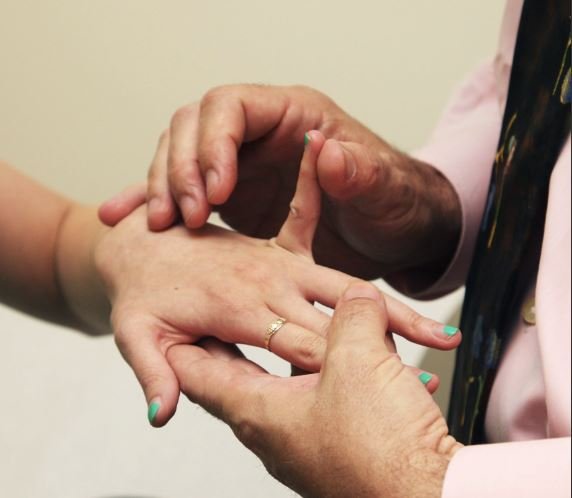
Our patient had hypermobile Ehlers Danlos syndrome.
Ehlers-Danlos syndrome is an inherited group of connective tissue diseases, characterized by collagen abnormalities affecting skin, joints, and blood vessels. It was first described as a bleeding disorder by Hippocrates in 400 BC.
There are 13 inherited genetic conditions are called Ehlers-Danlos( ED). One type, the vascular type, carries a high risk for aortic tears. Hypermobile ED (hED) does not cause aortic dissection. Patients with the condition may have fatigue, easy bruising, anxiety, dizziness with standing and digestive issues in addition to hypermobile joints. Hypermobile ED is the only form of Ehlers Danlos which does not have a known genetic cause leading to confusion about the diagnosis since so many complaints have been associated with it.
CLINICALLY
Since there is no genetic test for Ehlers-Danlos a set of clinical tests, The Beighton score, has been devised which make it likely.
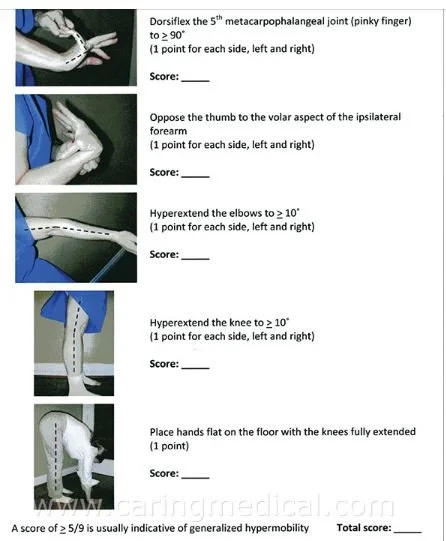
In addition to the Beighton score, all other hypermotility syndromes must be excluded including Marfans, and neuromuscular disorders. Autoimmune rheumatologic conditions like rheumatoid arthritis or lupus must be excluded. In order to make the diagnosis, there must be skin fragility. Elasticity, where the skin stretches 1.5 cm on the forearm, is common in hypermobile EDS.

The skin should stretch 1.5 cm or more to make the diagnosis of hypermobile Ehlers-Danlos
DIAGNOSTICALLY
Unfortunately, skin biopsies cannot detect abnormal collagen using light microscopy but atomic force microscopy (AFM) shows that some of the collagen is disrupted in hypermobile ED.
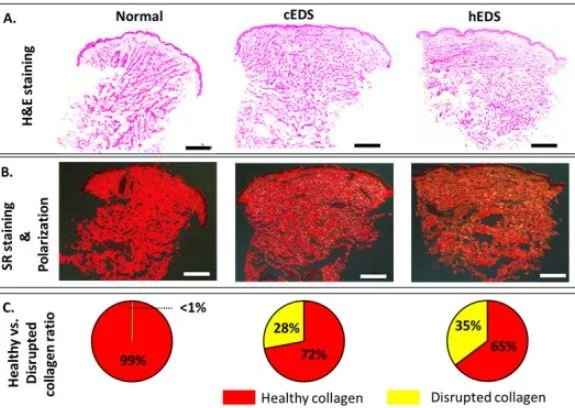
the abnormal collagen in ED can vary widely; in this study hypermobile ED had more abnormal collagen than cED(genetically proven ED)
Although all types of Ehlers-Danlos are potentially life-threatening, most people live a normal life span. Those with blood vessel fragility have the highest risk of fatal complications. In the hypermobile type of ED, there are a wide range of both symptoms and presentations. The diagnosis is further complicated by the fact that 20% of normal people have hypermobile joints. Hypermobility is naturally more common in children, women, and people of Afro-Caribbean or Asian descent. It is also very common in dancers, gymnasts, yoga enthusiasts and musicians.
TREATMENT
There is no treatment for hypermobile ED other than symptomatic. Individuals often benefit from the diagnosis because they are reassured that they have a medical condition. Currently, hED is a hot topic among influencers who claim they were misdiagnosed as psychiatric illness when they actually had hED.
FUN FACTS
Ehlers Danlos was thought to be a condition which allowed Niccolo Paganini to play wider fingerings than a typical violinist.
Yvie Oddly , a drag queen, has hypermobile Ehlers Danlos.

https://www.ehlers-danlos.com/wp-content/uploads/2017/05/hEDS-Dx-Criteria-checklist-1.pdf
https://caringmedical.com/prolotherapy-news/prolotherapy-ehlers-danlos-syndrome/
Parapia L, Jackson C Ehlers-Danlos syndrome—a historical review. Br J Haematol. 2008 Apr;141(1):32-35.
Neshatian M, Mittal N, Huang S, et al. Investigation of dermal collagen nanostructures in Ehler-Danlos Syndrome patients. PLoS One. 2924 Aug 22;19(8):e0307442,
Lattouf R, Younes R, Lutomski D, et al Picrosirius red staining: a useful tool to appraise collagen networks in normal and pathological tissues. J Histochem Cytochem.2014;62:751-758.
In the only study I found where hypermobile ED was found to have abnormal collagen, sirus red (SR)was used to bind to collagen. This Sirus Red dye carries a strong negative charge and interacts with the cationic collagen fibrils due to sulfonic acid groups in SR. When it binds to collagen abnormal collagen can be seen in polarized light.