A 65 y,o. male with a history of an implantable defibrillator for heart failure comes to the ED with shortness of breath.
What do you notice on his csr?
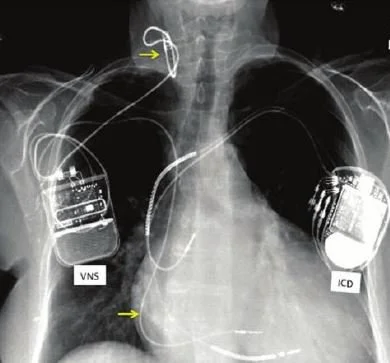
hint: it’s at the arrow
The patient has a vagal nerve stimulator with a battery implant and an implanted defibrillator.
VAGAL STIMULATION IN HEART FAILURE
The rationale for stimulating the vagus nerve is that sustained sympathetic hyperactivation aggravates congestive heart failure. Since the vagus nerve causes parasympathetic activity, it counters this effect. Vagus nerve stimulation causes acetylcholine to be released which binds to presynaptic terminals in cardiac tissue inhibiting the release of norepinephrine. Vagal stimulation releases acetylcholine into the SA node which slows the heart rate, It alters the RR interval from beat to beat in a fraction of a second.
The R-R interval variability is low when the sympathetic system assumes dominance since it takes much longer to release NE. So far vagal nerve stimulators have not shown benefit for chf.
Vagal stimulation is used for other conditions, most recently for it’s immune stimulation effect.
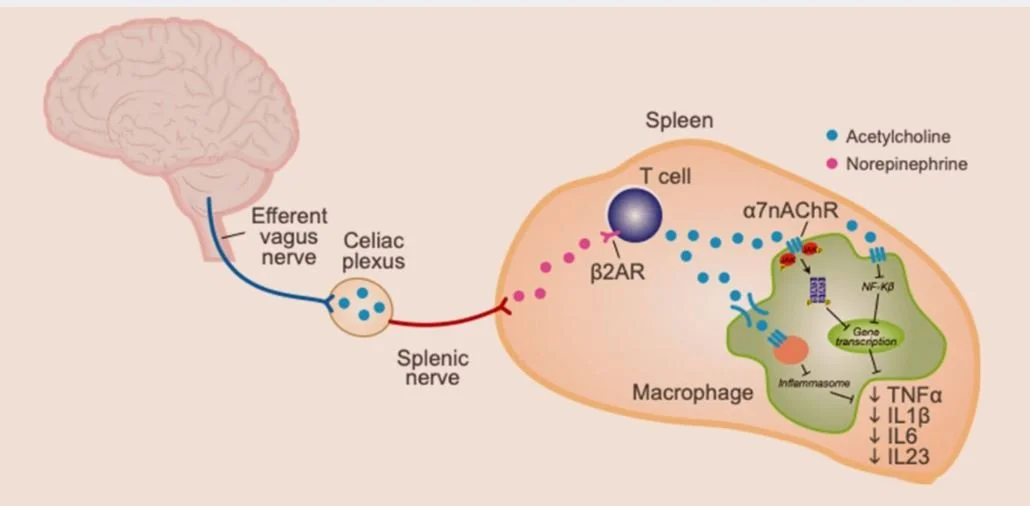
the diagram above shows its effect on the immune system.
VAGAL STIMULATION IN RHEUMATOID ARTHRITIS
Since chronic inflammation contributes to many autoimmune diseases like RA, inflammatory bowel disease and multiple sclerosis, decreasing inflammation is thought to mitigate the course of the disease. The vagus activates a cholinergic anti-inflammatory pathway. The nerve endings release the neurotransmitter acetylcholine, which binds to alpha-7 nicotinic receptors on macrophages and other immune cells This stops the release of pro-inflammatory cytokines such as TNF-alpha. Vocal cord paralysis and hoarseness have been reported. This is currently FDA approved for RA.
VAGUS STIMULATION FOR OTHER DISEASES
Refractory seizures- a vagus nerve stimulator along the carotid interrupts the electrical signals in the brainstem and can abort a seizure.
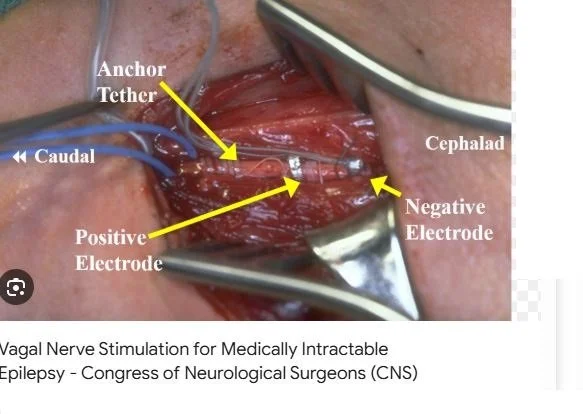
open procedure for vagal stimulator
Migraines- vagal stimulation has been suggested for migraines because it interrupts pain signaling in the brainstem.. Other claims have been made for vagal stimulation; curing TMJ discomfort, stress relief, and even improving longevity.
But…..
The devil is in the details. How long should the vagal nerve be stimulated.? In the cardiac studies the R-R interval variability was used to titrate the amount. The pulses were given in 14 second bursts and variation in the R-R interval was felt to be an indication of autonomic effect. In the rheumatoid arthritis studies, active stimulation intensity was set to an upper comfort level (maximum = 2.5 mA) and delivered a 1-min train of pulses to the vagus nerve once daily at 10 Hz.The study of RA patients recorded a reduction in symptoms in 50% of patients at one year. Short repeated daily pulses have demonstrated suppressed cytokine production and sustained reduction in chronic inflammation lasting weeks or months.
FUN FACT
Vagus nerve stimulators have become big business. Two of the six most popular vagal nerve stimulators don’t deliver electrical vagus nerve stimulation at all, they use ultrasound. Some stimulate only one vagus nerve. Yet influencers promote their use.
Bilateral vagus nerve stimulation is only considered safe if it begins at the outer ear since the ear branch of the vagus bypasses the cardiac motor fibers avoiding stimulation of the sinoatrial node.
Our patient did not have improvement in his congestive heart failure.
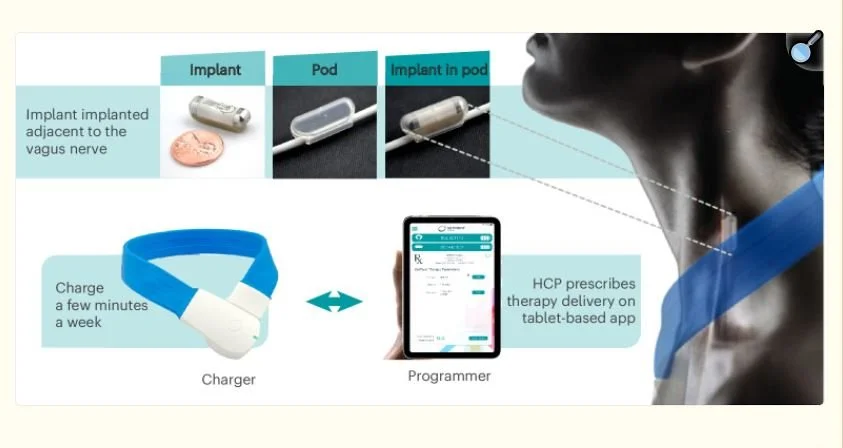
this newer model of vagal stimulator was used in the RA studies
Konstam M, Eudelson J, Mann D, et al. Vagal nerve stimulation in patients with heart failure and reduced ejection fraction: the ANTHEM-HFrEF trial. JACC 2026. Vol 87(25):3490-1502.
Tesser J, Crowley A, Box E, et al. Vagus nerve=mediated neuroimmune modulation for rheumatoid arthritis: a pivotal randomized controlled trial. Nature Medicine. 2026 32,369-378. 243 enrolled
Falvery A. Vagus nerve stimulation and inflammation: expanding the scope beyond cytokines. Bioelectron Med. 2022 De1;8(1):19;