A 40 y.o woman woman is brought to the ED by family because she woke up and was unable to walk.
Hint :her K was 2.6 but the answer is in the ultrasound shown below.
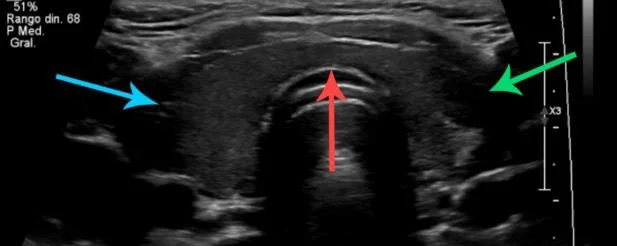
there is a nodule in the L lobe of the thyroid
Our patient had hyperthyroidism caused by a thyroid nodule and a condition called thyrotoxic periodic paralysis . This is caused by increased stimulation of the Na-K ATPase pump in muscle by thyroid hormone causing a rapid shift of potassium into cells leading to low blood potassium levels. This can be triggered by high carb meals or stress usually occur in the evening or early morning. It is also triggered by rest after exercise.
A prodromal period of several days marked by muscle stiffness can occur which progresses to paralysis starting in the lower limbs.Many individuals affected by thyrotoxic periodic paralysis are Asian males. The paralysist is triggered by various inciting agents: carbohydrates alcohol, exercise, stress and glucocorticoids.
Hypokalemic periodic paralysis causes a similar clinical picture.. This condition begins in late childhood and continues episodically through life with each episode lasting hours to days. It is a genetic disorder with alterations in the CACNA1S or SCN4A gene. Since it is triggered by the hypokalemia; it is treated with IV KCl if the attack is severe and acetazolamide, as a preventative measure, as an outpatient.
T3 toxicosis might also be considered in our patient. T3 toxicosis often occurs in early Graves disease. In this condition T4 is normal but TSH is low and T3 elevated.
The differential for sudden weakness includes Guillain- Barre, myasthenia and inflammatory myopathies. While a toxic nodule, as in the case of our patient, can trigger hyperthyroidism most commonly it is caused by Grave’s disease.
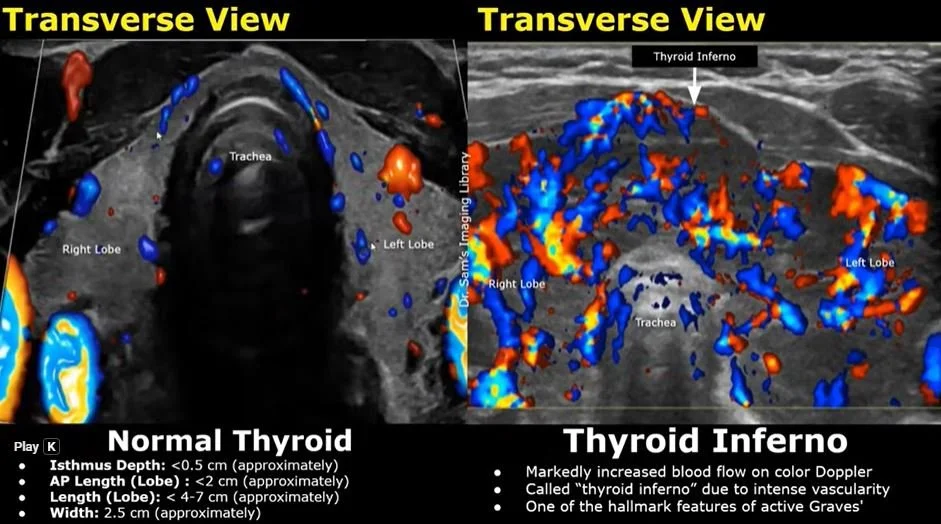
In Grave’s disease the thyroid is hypervascular
CAUSES OF HYPERTHYROIDISM
Graves disease 60-80%
Solitary toxic nodule 5%
Multinodular goiter 15%
Gestational hyperthyroidism- HCG acts as an agonist for thyroid-stimulating hormone. In hyperemesis, molar pregnancy and even the first trimester this overrides the normal feedback and causes hyperthyroidism.
Struma ovarii- ectopic thyroid hormone produced by an ovarian teratoma. Testicular tumors and choriocarcinoma can also cause hyperthyroidism.
Thyroiditis- inflammation of the thyroid from any cause (virus, bacteria and mycobacteria), virus, bacterial infection. Drugs like amiodarone, Li, or interleukin-2 or radiation also can cause hyperthyroidism. Thyroiditis causes damage to thyroid cells causing them to leak preformed T3 and T4 into circulation. Since this does not cause TSH-receptor Ab stimulation and thyroid hyperplasia, increased blood flow is not seen on doppler US. Following the episode of hyperthyroidism, hypothyroidism often often results as in Hashimoto’s.
Our patient had increased uptake over the nodule on her thyroid scan. She was treated for hyperthyroidism with methimazole and her K was replaced. Her muscle strength improved.
FUN FACTS
One in 8 women has some form of thyroid disease. 60% are unaware of their condition.
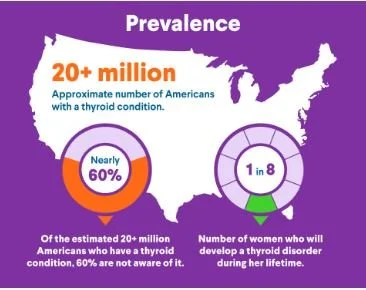
throid disease is very common in the US
After a nuclear accident individuals are given iodine because the accidents releases radioactive iodine into the atmosphere which is absorbed by the thyroid and can cause cancer. If individuals have a pre-existing thyroid nodule they can develop hyperthyroidism.
Neki N, hyperthyroid hypokalemic periodic paralysis. Pak J Med Sci. 3016 Jul-Aug;32(4):1051-1052.
Puente R, Moreno P, Munoz A, et al. Rare hyperthyroid complication Cureus 17(4). E83289. Doi:10.7759/cureus.83280.
Atrash J, Musleh T, Naji Y, Said V, Saraheen M: Thyrotoxic periodic paralysis: a unique case highlighting the diagnostic challenges and management. Cureus. 2024, 16:e73275. 10.7759/cureus.73275
Chao A, Akhondi H. periodic paralysis syndromes: a T3 thyrotoxicosis case and review of literature. HCA Healthc. J Med 2020Feb 37;1(1):27-33,
Barahona M, vinagre L, Sojo J, et al. Thyrotoxic periodic paralysis: a case report and literature review. CM&R.Sept 200996. Doi:https://doi.org/10.312/cmr.2009.816
@DrSamsImagingLibrary Thyroid Ultrasound Normal Vs Hashimoto Thyroiditis Imaging Findings | Acute & Chronic Stages USG: https://youtu.be/MJeYWQugY6U