A 20 y.o. male comes to the ED with syncope.
This is his EKG. What two things should be considered?
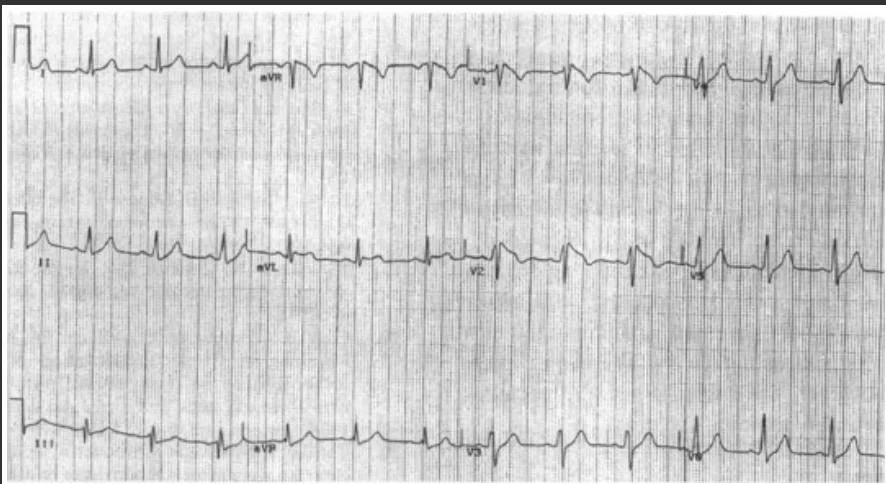
Our patient had a Brugada’s pattern induced by cocaine. Right bundle branch block with coved ST-segment elevation in leads v1 through v3 is the electrocardiographic marker of Brugada syncrome. . His EKG when he was not using cocaine is shown below.
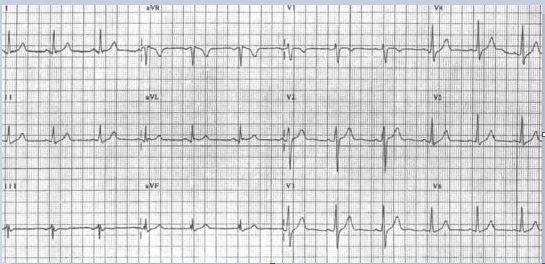
Two things to consider when you see a Brugada’s pattern are: the genetic channelopathy and drug effects causing a transient EKG change. One is deadly and the other felt to be benign.
GENETIC BRUGADA’S
The genetic form of Brugada was originally formally described in 1992. Two Spanish brothers were studying a 3 y.o. Polish boy who had been revived multiple times from cardiac arrests. His sister had died of sudden death at age 2. Initially, it was not clear whether this represented a right ventricular arrhythmia from a cardiomyopathy or a chromosomal abnormality. Chromosomal abnormalities in patients with structurally normal hearts were described on Chromosome 3 in 1998 by Chen who named it Brugada’s disease.
Brugada’s is a life threatening cardiac disease which is caused by an autosomal dominant sodium channel gene mutation in SCN4A. It can cause ventricular tachycardia, v fib, and sudden death in young individuals. In the genetic form of Brugada’s those with a history of sudden death, symptomatic patients with syncope, and those with inducible arrhythmias require a defibrillator.
DRUG AND EXERCISE INDUCED BRUGADA’S
The EKG pattern is felt to be benign in those who are asymptomatic or exposed to drugs like cocaine.. It acts as a sympathomimetic increasing catecholamines by inhibiting noradrenaline reuptake, and causes ventricular irritability with arrhythmias. Cocaine is a potent sodium channel blocker and can produce an EKG similar to Brugada’s disease. Extreme exercise can also cause a Brugada’s pattern especially in athletes with RVH. An estimated 2% of athletes have the Brugada pattern because of high autonomic tone. This goes away after deconditioning.
Drugs that induce a Brugada’s pattern include:
Cocaine
Antiarrhythmics- procainamide, flecainide
Antidepressants- amitriptyline, lithium
Anesthetics- propofol
THE CONTROVERSY
While chromosomal analysis can identify patients with the genetic abnormalities. many patients with the genetic form of Brugada’s are asymptomatic and never require internal defibrillators. Deciding who needs an AICD is difficult. Electrophysiologic efforts to induce ventricular fibrillation in a controlled setting are useful and those with a family history of sudden death, syncope or documented ventricular fibrillation are at highest risk.
Our patient’s EKG returned to normal and he was advised to discontinue cocaine use.
INTERESTING FACTS
Prolonged QT syndrome is also associated with sudden death and can be genetic or acquired. While the genetic variant was initially thought to be related to potassium channels; 10% of cases are related to sodium channels with blockage of the inward sodium current. An abnormality of the inward sodium current prolongs repolarization and prolongs the QT interval. In this condition if the QT interval does not shorten when the heart rate increases ventricular fibrillation may ensue.
The most common drug prolonging the QT is azithromycin.
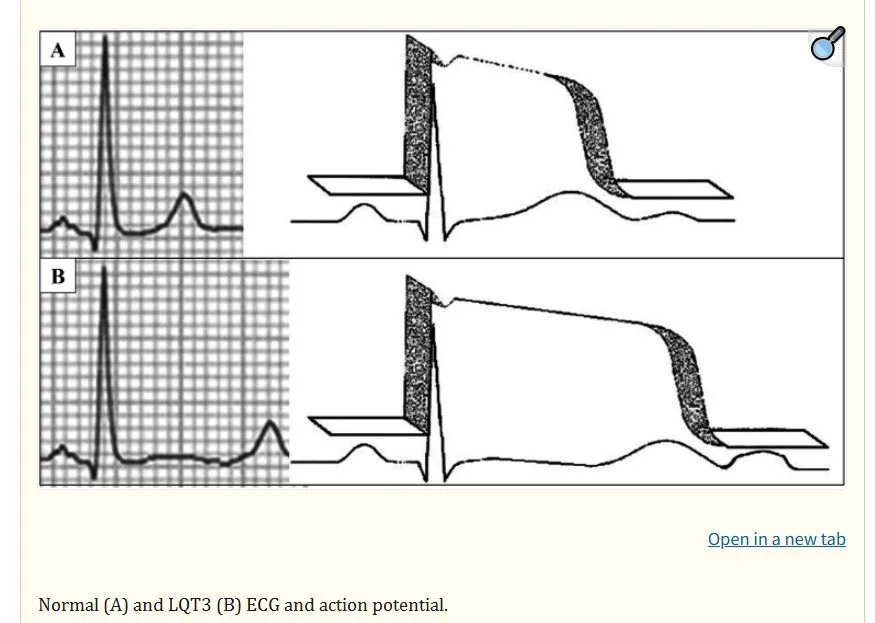
500 msec is considered a worrisome QT interval.
Littmann L, Monroe M, Svenson R. Brugada-type morphology of either type 1 or type 2, but with < 2 mm of ST-segment elevation and a positive T wave. Diagnosis of Brugada syndrome depends on characteristic ECG findings and clinical criteria.
Drug-induced Brugada syndrome. Yap YG, Behr ER, Camm AJ. Europace. 2009;11:989–994. doi: 10.1093/europace/eup114.
Noori M, Fichadiya H, Jsani S. et al. A rare yet morbid complication of cocaine use: brugada type 1 on electrocardiogram. Cureus 2022 Apr 20;14(4):e24309.
Littmann L, Monroe M, Svenson R. Brugada-type electrocardiographic pattern induced by cocaine.2000. Case Report Vol 75(8).
Schwartz P, Crotti L. Long QT syndrome. NEJM. 2025. 393;20:2023-2033.