A 74 y.o. male had an episode of vomiting and received an abdominal xray.
The xray was read as normal and he subsequently recovered but you notice something about the spine and order a lateral.
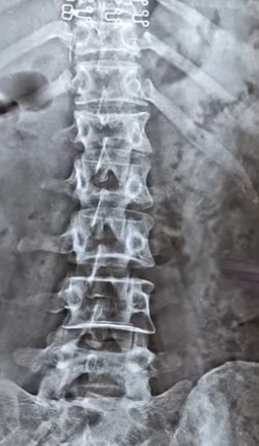
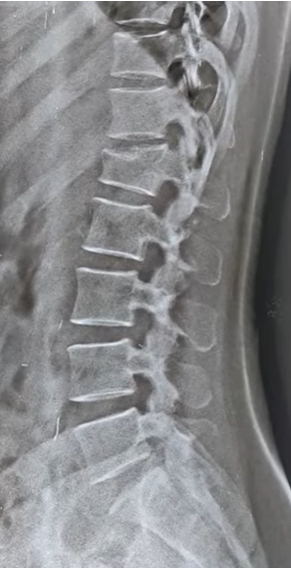
iIt is easier to see on the lateral. There was no trauma. What do you tell the patient?
Our patient has an L1 compression fracture defined as a fragility fracture, since no trauma was reported. Often no trauma is reported or the patient has a same level fall. It is a stable fracture and the patient has no pain but he is at high risk of another fracture especially in the next two years. He should be referred for an evaluation for osteoporosis.
Only one in five patients with a fragility fracture is getting treatment for bone health. In a large survey of chronic disease called the HEDIS (Healthcare Effectiveness Data and Information Set) study. Even those with fractures, in the last column, were not being treated for osteoporosis.
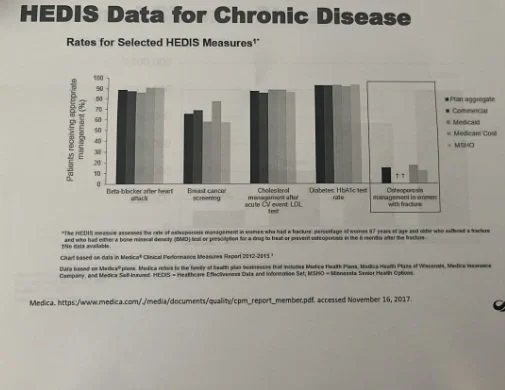
while beta blockers are given for MI, HbA1C is tested for diabetes. patients with a fragility fracture are rarely referred for treatment although they have insurance.
Sustaining one fragility fracture causes inflammation and greater bone loss at a rate five times an age matched population.
THE DIAGNOSIS
There are two ways to make the diagnosis of osteoporosis. One is a fragility fracture; this automatically confirms the diagnosis. A second method is to measure bone density using a DEXA(dual x-ray absorptiometry) scan.
A Dexa scan measures bone density. if you are 2.5 standard deviations below the standard adult you have osteoporosis or osteomalacia (low vitamin D). The current recommendation is to get a bone density scan in your 60s; earlier if there is a family history of osteoporosis.
Osteoporosis fractures associated with low bone mineral density increase in incidence after the age of 50. They frequently occur at the hip , spine and forearm. Risk factors for osteoporosis include : smoking, thyroid disease, renal disease, alcoholism, hypogonadism, and low body weight.
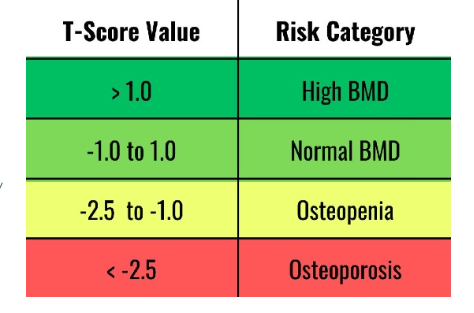
2.5 standard deviations below an age matched population is considered osteoporosis
THE TREATMENT
Diet: Calcium and 600-1,000 IU a day and Vitamin D of 600-1400 IU is recommended. Exercise: Walking increases bone density as well as lifting weights.
There are two general classes of drugs to treat osteoporosis anabolic treatments to grow new bone and antiresorptive therapy to prevent bone loss. A dread complication of osteoporosis treatment with anti-resorptive treatments ( Prolia, alendronate. Fosamax) is osteonecrosis of the jaw in 1 of 1000 patients. The purely anabolic agent teriparatide ( recombinant parathyroid hormone) does not cause osteonecrosis. A newer agent romosozumab has both effects; antiresorptive and anabolic bone growth. It has been used off label to treat osteonecrosis of the jaw. It has been shown to increase lumbar spine density by 10-14% in one year. It is not recommended if you have cardiac disease or a recent stroke since it blocks sclerostin, a protein that slows down bone formation AND is also found in vascular smooth muscle and cardiovascular tissue.
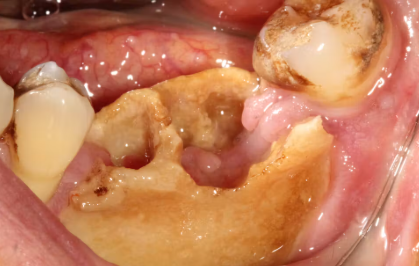
osteonecrosis of the jaw
Our patient was diagnosed with osteoporosis on the basis of a fragility fracture and was referred for evaluation of Ca, Vit D and bone density. This was done before a baseline DEXA scan since it cannot be done if the patient is on calcium replacement.
FUN FACTS
Astronauts experience severe bone mineral density loss (losing 1% to1.5%) of bone mass per month) due to microgravity.
In North America it is impossible to get enough Vit D from the sunlight alone.
Mahmud B, Vargas R, Sukhum K, et al.Longitudinal dynamics of farmer and livestock nasal and faecal microbiomes and resistomes. Nature Microbiology 2024 (9), 1007-1020
Dirschl D. Anti-osteoporotic therapy after fragility fracture lowers rate of subsequent fracture: analysis of a large population sample JBJS 2015/
Armando C, Fox E, Taylor K. Distal radius fractures as a call to action:reducing subsequent fragility fracture risk through early osteoporosis therapy. Geriatr Orthop Surg Rehabil. 2025 June 26;15:21514593241351180.
Bruns M. Recognizing and treating osteoporosis after fragility fractures. Lecture:Sept 2026.
Ross B, Lee O, Harris M, et al. Rates of osteoporosis management and secondary preventative treatment after primary fragility fractures. JBJS Open Access, 6(2),e20.
Shoback D, Rosen C, Black D, et al. Pharmacological management of osteoporosis in postmenopausal women: an Endocrine Society guideline update. The Journal of Clinical Endocrinology & Metabolism,105(3)587-594.
McClung MR, Brown JP, Diez-Perez A, et al. Effects of 24 Months of Treatment With Romosozumab Followed by 12 Months of Denosumab or Placebo in Postmenopausal Women With Low Bone Mineral Density: A Randomized, Double-Blind, Phase 2, Parallel Group Study. J Bone Miner Res 2018;33:1397-406. 10.1002/jbmr.3452