A 27 y.o. male comes in with a dogbite after receiving a puppy for Xmas?
What are you concerned about?

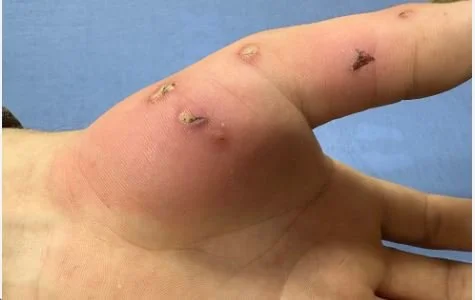
our patient had a cellulitis
Our patient’s new puppy had Capnocytophaga and infected him with a scratch.
Capnocytophaga is a gram negative bacterial infection only rarely transmitted from dogs to humans but should be in the differential for any wound occurring after interaction with an animal . Studies looking at the prevalence of Capnocytophaga canimorsus find it in 60-70% of dog saliva. Serious infection is most likely to be seen in dog bites or scratches when the patient has a risk factors, such as alcohol abuse, asplenia or immunosuppression. Due to slow growth cultures may not be positive for 14 days. Broad spectrum antibiotics are recommended.
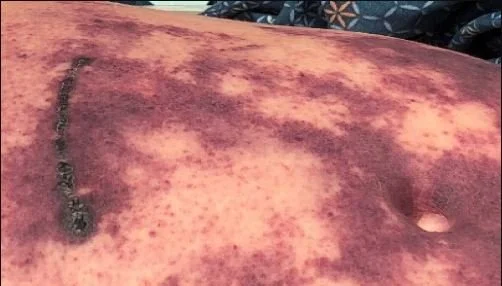
Overwhelming sepsis caused by capnophaga canamorsus in another patient.
While capnocytophaga is not the most common infection transmitted to humans; puppies carry a host of other pathogens.
1. Bacterial infections- Staph and strep are the most common bacterial infections. Salmonella, camphylobacter, capnocytophaga, and leptospirosis also occur.
2. Viral infections- rabies, norovirus and some influenza strains. Canine parvovirus is not transmitted to humans.
3. Fungal infections- ringworm, blastomycosis, histoplasmosis and coccidioidomycosis.
4. Parasitic infections-toxocariasis and Giardia. Giardia can be difficult to eradicate since the parasitic cysts are hardy and require diligent environmental cleaning . it may also become resistant to treatment.
The most serious of these is rabies. It can be transmitted from puppies under three months of age. Since rabies in adult dogs in the US has been eradicated by vaccination, the puppy would have to have been exposed to a raccoon, bat, coyote, fox or skunk. It can also be transmitted transplacentally in utero. The symptoms of rabies in a puppy are divided into hyperactivity and paralytic phases. The paralysis starts in the hind legs and spreads throughout the body resulting in a stumbling gait. It is recommended that all puppies receive a rabies vaccine at 12 weeks of age.
WHAT VACCINES ARE REQUIRED FOR A PUPPY?
Distemper, adenovirus-2 (causing kennel cough) and Parvo are recommended in a series. These cannot be transmitted to humans. Canine parvo is not the same virus as the B19 parvo which causes Fifth Disease in children.
The initial DAP vaccine should be given to puppies when they are 6–8 weeks of age. Boosters are given every 2–4 weeks until the puppy is 16–20 weeks old. These boosters are essential as immunity provided via the mother’s milk may render the early vaccinations useless. An additional DAP booster at 1 year of age also is needed. Rabies is recommended at 12 weeks. In addition to vaccines, puppies also need worming.
The first worming takes place at 2-3 weeks of age because they often get worms from their mothers. This is repeated every two weeks until they are 12 weeks and then monthly until six months.
FUN FACTS
Rabies is not native to North America but was thought to be introduced by the Columbian exchange. Rabies originated in Old World bats and was thought to be introduced with infected animals from Europe as trade ensued.

Our patient was treated with augmentin and recovered successfully. In the immune compromised, imipenem or piperacillin-tazobactam is recommended by the CDC.
Klumpp L, Liu-Young G, Craig J, et al. Dpg scratch fever secondary to Capnocytophaga species in a patient without risk factors. J of Infectious Dis and Epidemiol.6:110. Feb 12,2020. ISSN:2474-3658
Taylor S, Iftikhar N, Sherin K, et al. Dog bite to the hand: infectious disease considerations, Cureus 16(8) e65964. Doi:10.7759/cureus.65964
https://www.akc.org/expert-advice/health/puppy-shots-complete-guide/L
Perterson C, Abel W, Reddy V, et al. furry,fomite and facultative anaerobe: a unique case of capnpcytophaga canimorsus.Cureus. 2023 Oct 26;15(10):e47747.