A 27 y.o male returns from canoeing in northern Minnesota. He co a pruritic rash.
What does it represent?
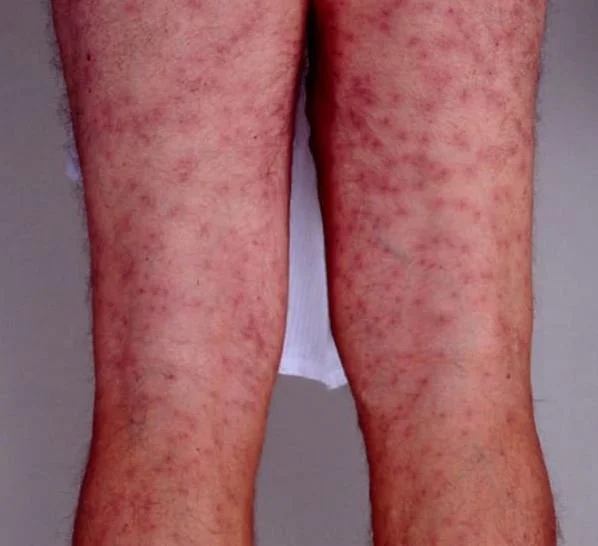
Our patient had cercarial dermatitis or swimmer’s itch. It is caused by a fresh water flatworm parasite often found in ducks.
Ducks carry the adult worms and pass eggs in their feces. These develop in the snail which is the intermediate host ,continuing the cycle. Snails release free-swimming larvae called cercariae. The larval stage(cercariae) can penetrate the skin of swimmer’s causing an allergic reaction. While it can cause an itchy rash, the cercariae do not mature into adults in humans.
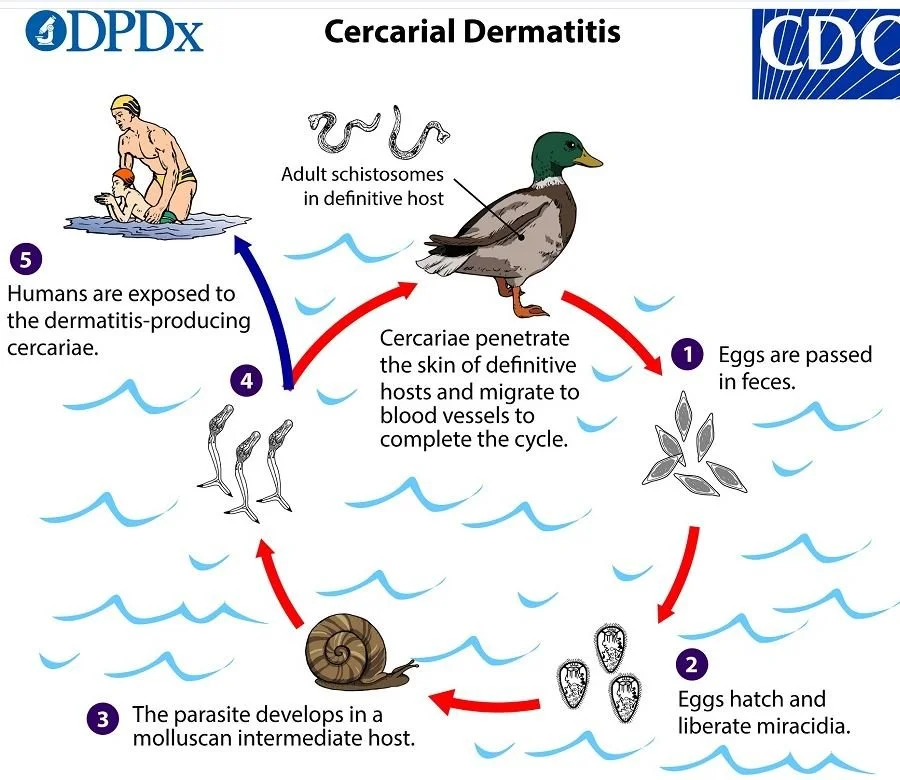
snails are an intermediate host
CERCARIAL DERMATITIS
Adult parasites live in the blood of infected aquatic birds like mergansers, mallards, geese and animals like muskrats. They are commonly associated with outbreaks in the lakes of northern Minnesota. The rash typically begins about 12 hours after exposure and lasts one week. The snails at Pelican Lake in Minnesota cause a rash which is 40 times more severe than more common types and the culprit host has been traced to merganser ducks. Efforts are currently underway to trap and remove the mergansers.

The merganser is not a mallard: it has a long narrow red beak with serrated edges to catch fish.
SEABATHERS DERMATITIS
Swimmer’s itch is not to be confused with seabathers eruption caused by the larval stage of jellyfish (cnidarians). This salt water dermatitis is usually found under the garments worn by bathers where the organisms are trapped after the person leaves the water. This dermatitis is caused by a 3mm free swimming larval stage of jellyfish called an ephyra. This is not a jellyfish “sting”because there are no tentacles involved but the larval phase contain developing nematocytes which contain a toxin. These jellyfish are found along the southeast coast of the US, Florida and the Gulf of Mexico. The incidence is highest in May and June. Warm water and increasing ocean temperatures are responsible for an increase in cases. Shallow water or slow moving water should be avoided. In treating nematocyte stings fresh water and pressure will cause nematocytes to release more toxin and are to be avoided.
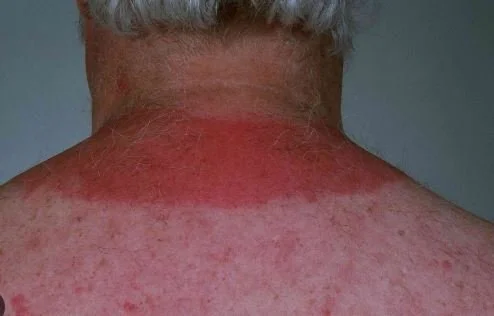
seabather’s dermatitis can occur under a wet suit
FUN FACT
Zebra mussels,an invasive species, may be responsible for an increase in Stagnicola emarginata snails that host the parasites. They are filter feeders and by voraciously eating the algae in the water, more light penetrates to the attached algae which is a primary food source for the native snails . As the native snails increase in number, the amount of cercariae in the water increases.
https://www.cdc.gov/dpdx/cercarialdermatitis/index.html.
https://www.mayoclinic.org/diseases-conditions/swimmers-itch/symptoms-causes/syc-20355043
Hornbeak KB, Auerbach PS. Marine Envenomation. Emerg Med Clin North Am. 2017 May;35(2):321-337.
Menahem S, Shvartzman P. recurrent dermatitis from jelly fish envenomation. Can Fam Physician 1994 Dec;40:2116-2118.
Prohaska J. Jamal Z, Tanner L. Seabathers eruption. Treasure Island (FL): StatPearls Publishing; 2025 Jan.i