A 50 y.o. male was bitten on the dorsum of the hand by his pet macaw.
He had been drinking and 12 hours later when he woke up he noted he could not move his hand.
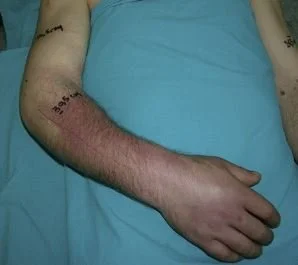
what are you concerned about ?
Our patient had a crush injury from a parrot bite on the hand that may have been aggravated by sleeping on his arm. When he presented to the ED he had compartment syndrome of the hand and arm. The arm was swollen and painful and his fingers were held in flexion. His creatinine was 3 and K was 7.3.
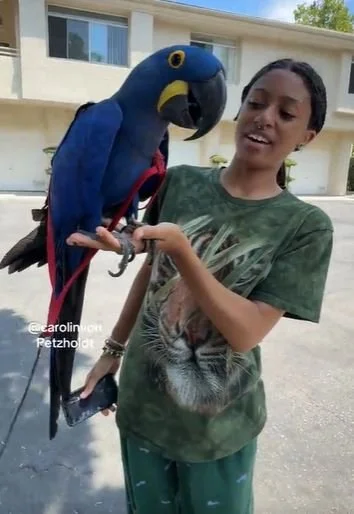
macaws can inflict serious bites.
Hand injuries from domestic animals are a common ED complaint. They result in 300,000 ED visits per year. Although less common than dog or cat bites, parrots pose a unique problem. Large parrots like hyacinth macaws can apply forces of up to 1,200 pounds per square inch putting individuals at risk for severe crush injury and compartment syndrome. This can occur without any penetration of the skin; however lacerations are the most common injury.
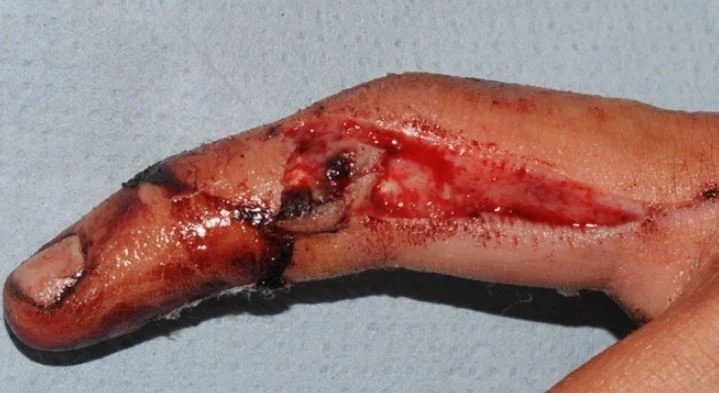
parrot bite with middle phalanx fracture.
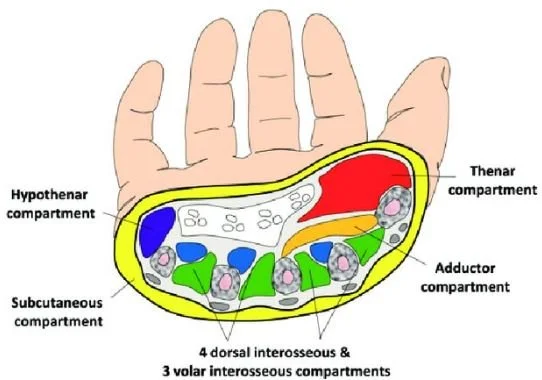
Signs of compartment syndrome are: pain, pallor, paresthesia, paralysis, poikilothermia and in severe cases; pulselessness. The hand has 10 compartments with four interossei compartments and parts of the thenar and hypothenar compartments on the dorsal surface. The thenar and hypothenar eminence are opened during a fasciotomy.
While serious parrot bites are not a common problem in the ED, compartment syndrome is seen. Fractures account for 75% of cases with fractures of the tibia being most common. Crush injuries , severe burns, tight casts and bleeding disorders are also known to cause compartment syndrome. Cases have been reported of compartment syndrome with IV fluid extravasation.
Our patient was taken directly to the OR after treating his hyperkalemia with insulin, NS and glucose. Rhabdomyolysis was noted. No fractures were noted. A fasciotomy of the forearm and hand was done with carpal tunnel release.
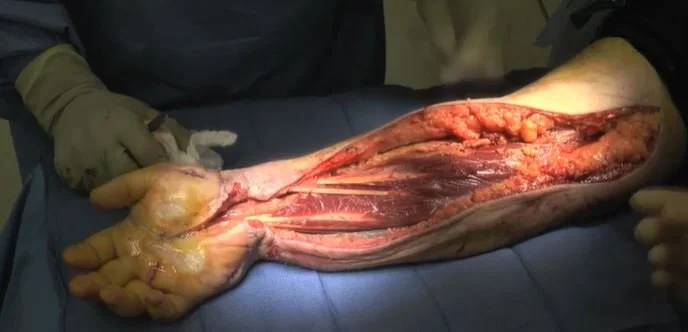
hand and forearm fasciotomy
Because of the parrot bite, antibiotics were instituted. Parrots are known to harbor E. coli, Pasteurella meltocida, C. psittaci, and mycobacterium avium. He was initially treated with augmentin and doxycycline. No abscess was found. and cultures were negative. The wound was left open and a second surgery was done in two days. Compartments were soft at that time and eventually the wound was closed. The patient recovered hand function after physical therapy.
Managing parrot bite injuries to the hand: not just another animal bite. King ICC, Freeman H, Wokes JE. HAND (N Y) 2015;10:128–130. doi: 10.1007/s11552-014-9644-8.
Dotson M, Mullen J. Acute compartment syndrome of the hand from a parrot bite. Cureus. 2019 Jan 8;11(1):e3845.
Wong V, Hanwright P, Manahan M. Can extravasation injury cause subcutaneous compartment syndrome of the hand? Plastic Surgery Case Studies 3(3):2513826X1722825.
Barber C, Fahrenkopf M, Adams N, et al. compartment syndrome of the hand secondary to intravenous extravasation.
https://www.aaos.org/videos/video-detail-page/?id=26811__Videos
Azad, A., Paksima, N. (2021). Compartment Syndrome Forearm and Hand. In: Tejwani, N.C. (eds) Fractures of the Wrist. Springer, Cham. https://doi.org/10.1007/978-3-030-74293-5_13
Tachtsi M, Kalogirou T, Atmatzidis S. et al. Acute forearm compressive myophathy syndrome secondary to upper limb entrapment:an unusual cause of renal failure. Annals of Vaculars Surgery, 25,559.e1-559e5.n