A 70 y.o. man presents to the ED five days after a fishing trip with ataxia and leg weakness
Could this have anything to do with the fishing trip?

This is the lake in Louisiana where he was fishing.
Our patient had tick paralysis. It is caused by a neurotoxin in an attached pregnant female tick. This occurs with many tick species including the dog tick Dermacentor which was attached to our patient.
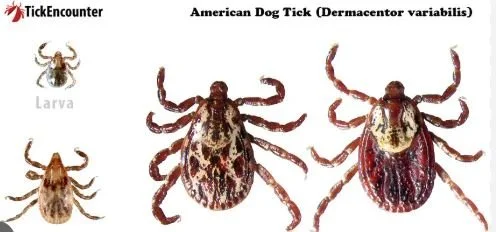
dog ticks are also called wood ticks and when swell with blood when feeding.
Tick paralysis was first described in Australia in 1823 when animals were found dead and covered with ticks. Later, extracts of tick salivary glands were injected into mice producing paralysis. The toxic effects were prevented by pretreatment with a serum obtained from dogs on which large numbers of ticks were feeding, producing an antitoxin that prevented paralysis.
Tick paralysis is caused by a neurotoxin secreted in the saliva of a female tick while it is feeding . The toxin produced is similar to botox; ixobotoxin. This inhibits the release of acetylcholine at neuromuscular junctions. Without acetylcholine, muscle fibers cannot be activated causing flaccid paralysis. Rarely, respiratory paralysis can result in death.
CLINICAL MANIFESTATIONS
While tick bites are common, tick paralysis is rare. The tick must be attached and feeding for several days for paralysis to occur. The classic presentation is an acute symmetric ascending paralysis that evolves over hours to days. Sometimes preceded by paresthesias, areflexia, and ataxia. Presentations can vary with some individuals developing cerebellar symptoms and ophthalmoplegia. It resembles Guillian-Barre but with negative imaging and LP results.
TREATMENT
The treatment is to remove the tick. Once the source of the toxin is removed symptoms resolve in 24-72 hours.
TICKS CAUSING DISEASE IN THE US.
Black legged ticks- deer ticks are vectors for Lyme, anaplasmosis and babesiosis
Lone star ticks- transmit Ehrlichiosis, tularemia and STARI (southern tick associated rash illness) They also trigger Alph=gal syndrome. They do not transmit Lyme disease.
Asian long horned ticks-Erhlichiosis, babesiosis, Heartland virus. They do not have long horns but rather sharp outward pointing mouth parts.
Dog ticks-Wood ticks are unique in that they can live indoors year-round. They transmit Rocky Mountain spotted fever.
While these are the most common ticks to transmit disease, many species can transmit other diseases. The key to treatment is doxycycline. While only 1 out of 100 attached ticks transmit Lyme, the CDC recommends treatment if the tick has been attached for 36 hours and it is within 72 hours of exposure. If a target rash develops 10-14 days of doxycycline or amoxicillin is recommended.
Dog ticks are common in Louisiana especially in grassy areas . Screening for tick-related diseases included: anaplasmosis, babesiosis, Lyme and Rocky Mountain spotted These were negative in our patient as well as an MRI and LP.
Our patient was admitted to the hospital where a nurse found a tick in the gluteal cleft. The tick was removed and all symptoms were gone in 24 hours
FUN FACTS
Dogs can also get tick paralysis. They do not get alpha-gal syndrome because alpha-gal is a sugar normally produced in dogs. The antibodies they produce have not been shown to produce reactions to red meat.
Due to global warming, ticks are increasing worldwide. Many new species are coming to the US from foreign countries both on people and animals. The Asian longhorned tick was first identified in 2017 as a cause of Erlichiosis and fatal anemia in cattle.
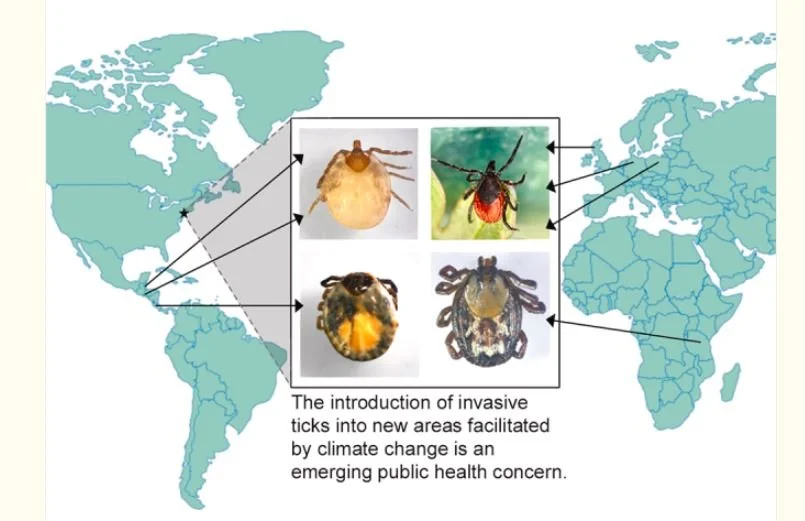
new species of ticks often come to the US on exotic animals.
Laufer C, Mhiota-McCollum N. A case of subacute ataxia in the summertime: tick paralysis. J Gen Intern Med. 2015 Mar 21;30(8):1225-1227.
Edlow JA. Tick paralysis--a rare but important tick-borne disease. JAMA Internal Medicine.2024. vol 184(11) :1393-1395.
A 70 y.o. man presented to the ED five days after a fishing trip in June in Mississippi with difficulty walking. On exam he had marked truncal ataxia.
Khalil N, Sandland L, Molaei G. Cross=continental hitchhiking of exotic ticks on human travelers and ensuing public health challenges in the USA. I Science. 2025 Aug 8;28(8):113223.
Dworkin M, Shoemaker P, Anderson. Tick paralysis: Clin Infect Dis. 1999 Dec;29(6):1435-9.
https://www.cdc.gov/ticks/data-research/facts-stats/geographic-distribution-of-tickborne-disease-cases.html