A 41 y.o. woman with a history of a Roux-en-Y gastric bypass comes in with abdominal pain, nausea and vomiting. The CT is shown below.
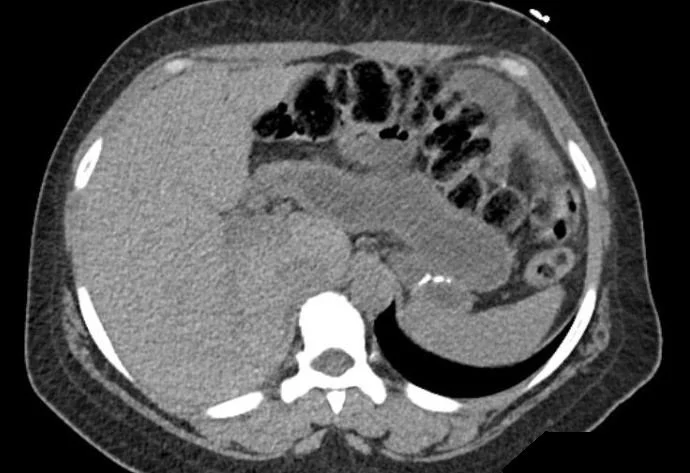
Hint: the Ct was read as focal colitis. What is in the differential?
Our patient had an incarcerated internal hernia after Roux-en-Y surgery for weight loss
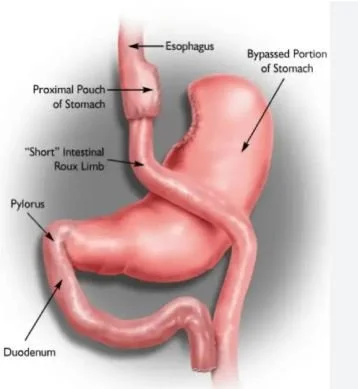
the Roux limb bypasses the stomach; the biliopancreatic limb has a jejunal anastomosis.
The “Y” is visible here
Gastric bypass is the most common cause of internal hernia after surgery. When the small bowel is divided and rearranged, there are gaps in the mesentery, the tissue connecting the intestine to the abdominal wall. Often this occurs behind the alimentary limb forming what is known as a Petersen’s hernia. The hernias can occur either Petersen’s space(68%) or at the biliopancreatic diversion site (the jejunostomy site) (28%). This is known as Brolin’s apace. In addition to the spaces in the mesentery caused by the surgery, rapid weight loss causes the fat in the abdomen to shrink making the defects in the mesentery larger. Small bowel loops protrude through the defect causing abdominal pain.
With the rise of laparoscopic gastric bypass the incidence of internal hernia has risen to between 11 and 16% because of the lack of adhesions caused by the laparoscopic approach. The bowel is free to move and most commonly travels through the Petersen space behind the alimentary limb.
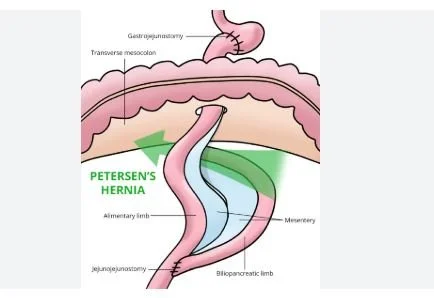
Brolin’s hernia is at the jejunal anastomosis while Petersen’s is behind the alimentary limb.
Our patient was admitted to a medical service with a surgical consult. She developed an elevated lactate and was taken to surgery. A laparoscopic approach was attempted but the hernia was unable to be reduced. An open procedure was then performed. The herniated and hyperemic bowel was actually the biliopancreatic limb extending from the JJ proximally up towards the ligament of Treitz. The hernia was untwisted and the mesenteric defects closed. The patient is recovering.
FUN FACTS
Dr. Walther Petersen was a German surgeon who first described 3 fatal cases of small bowel herniating through a mesenteric space after gastrojejunostomies in 1900. .
Cesar Roux was the swiss surgeon who first described the operation in 1892.
Nogoomi I, Nouh A, Jaber A et al. Petersen’s hernia after roux-en-Y gastric bypass: a case report Cureus 2023 Dec 18;15(12):35057.
de Bakker JK, van Namen YW, Bruin SC, de Brauw LM. Gastric bypass and abdominal pain: think of Petersen hernia.. JSLS. 2012;16:311–313.
Wong K, Awal W. radiology insights into Petersen’s hernia complication of post Roux-en-Y gastric bypass. Radiology Case Reports 2025. Vol20(3), 1695-1698.
Karcz W, Zhou C, Daoud M, et al. Modification of internal hernia classification system after laparoscopcd Roux-en-Y bariatric surgery. Wideochir Inne Tech Maloinwazyjne 2015 Jun10;10(20:197-204.
Petersen W. [Ueberdarmveschlingung nach der gastro-enterostomie] Arch Klin Chir. 1900;62:94–114.