A 35 y.o. comes to the ED with leg pain.
what could this represent?

Our patient had antiphospholipid syndrome with superficial thrombophlebitis of the leg.
Superficial thrombophlebitis is most commonly caused by varicose veins, injury or inactivity and felt to be benign. However, sometimes it can be a sign of a clotting disorder. Clinically, a phlebitis can be difficult to distinguish from a cellulitis although it often follows the outline of the vein.
Antiphospholipid syndrome is an autoimmune disease producing antibodies to phospholipid which activates endothelial cell complement causing thrombosis. The antibodies can be one of several types with the most common being anti-cardiolipin, anti-beta-2 glycoprotein and lupus anticoagulant. Clotting can occur in any organ but often presents with superficial thrombophlebitis of the skin.
In general, risk factors for superficial thrombophlebitis are the same as for DVT (think Virchow's Triad of hypercoagulability, stasis, and trauma). Conditions including pregnancy, history of vein excision/ablation, stasis from varicose veins, history of prior thrombosis, malignancy, and prior IV catheter placement all increase the risk for thrombosis.
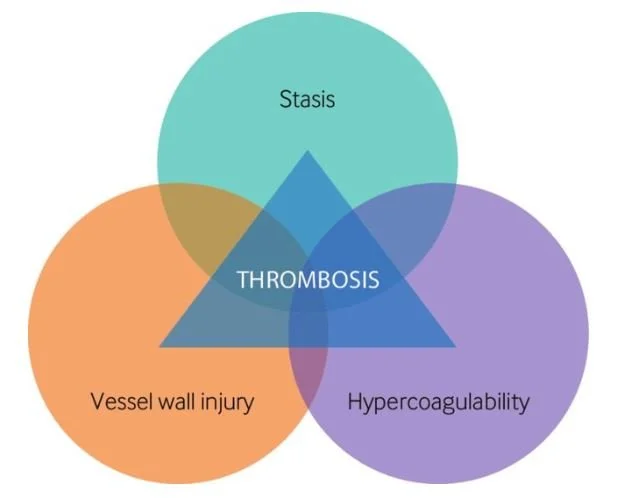
Virchow’s triad
Pregnancy is a hypercoagulable state. It is thought this adaptation evolved to prevent hemorrhage during childbirth. Clotting factors like fibrinogen, and factors VII, VIII, and X are increased. Antiplatelet antibodies are also more common in pregnancy as a result of the body’s immune alteration to tolerate the fetus. Thrombocytopenia complicates up to 10% of pregnancies and is probably why ITP is often discovered during pregnancy.
Our patient was treated with coumadin for her antiphospholipid syndrome and her clot resolved.
She did not have ITP although 30% of patients with ITP my have antiphospholipid antibodies. Those patients require some form of immune suppression if thrombocytopenia becomes severe. They are prone to both bleeding and clotting. Recently, blinatumomab has been used to successfully treat both antiphopholipid syndrome and ITP.
FUN FACTS
Mondor’s disease is a benign condition involving superficial thrombophlebitis in the breast or dorsal vein of the penis which resolves spontaneously in 4-6 weeks. It is thought to occur from trauma associated with sexual activity.

A venous cord from Mondor’s disease
Not all cases of antiphopholipid syndrome cause a prolonged PTT. It is usually prolonged when a lupus anticoagulant is present.
Prasad S, Xiong J, Embry E, et.al. Catastrophic antiphospholipid syndrome: a life-threatening condition.Case Reports Cureus 2024 Jul 11;16(7):e64367
Danan V, Harp J. Erican D. Antiphospholipid syndrome and skin problems-top 10 series. HSS
Gottschlich A Bucklein V, El-Marouk K, et al. Correspondence Blinatumomab in combined immune thrombocytopenia and antiphospholipid syndrome. NEJM. 2026 394(10).
Stavrou E, McCrae K. Immune thrombocytopenia in pregnancy. Hematol Oncol Clin North Am. 2009;dec;23(^)
Garcia D, Erkan D. Diagnosis and management of the antiphospholipid syndrome NEJM 2018.;378:2010-2023.
Leung A. POTD: Superficial thrombophlebitis Maimonides Emergency Medicine 2019