A 30 y.o male comes to the ED with decreased vision after being punched in the eye
What do you see?
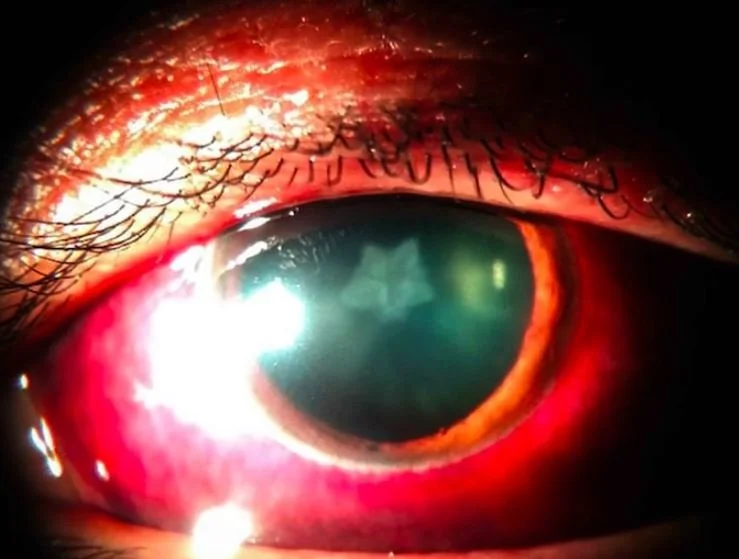
Other than 20/50 vision and a small corneal abrasion; he eye exam is normal
Our patient had a traumatic cataract. Traumatic cataracts are common after blunt eye injury. Up to 65% of eye traumas lead to traumatic cataracts. Occasionally, the lens may appear cloudy in a rosette fashion as in our patient. Traumatic cataracts can occur suddenly or over time. Cataracts developing after a lightning strike are often delayed months. Cataracts can be caused by exposure to laser light which can be absorbed by and damage the lens.
TRAUMATIC LENS INJURIES
Three other traumatic lens problems should be considered: a Vossius ring,a dislocated lens and phacolytic glaucoma.
A Vossius ring is a circle of brown pigment caused by deposition of brown pigment on the anterior surface of the lens capsule when the posterior part of the iris hits the lens after a blow to the eye. This is considered benign but prompts the look for other injuries.
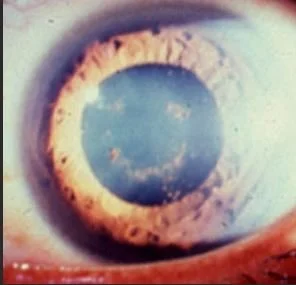
vossius ring on the lens
Dislocated lens- A dislocated lens occurs in about 5% of blunt eye trauma. The zonular fibers which hold the lens are ruptured and require surgical repair.
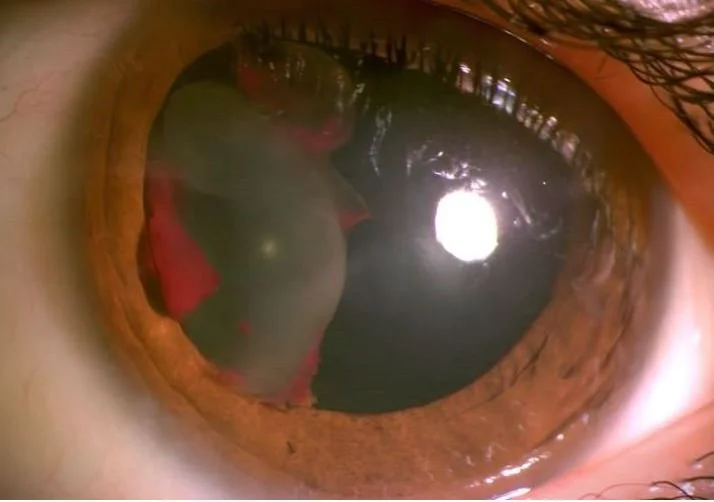
dislocated lens
Phacolytic glaucoma is increased eye pressure caused by a ruptured hypermature cataract If. the lens is damaged and leaks proteins, macrophages can obstruct the trabecular network causing an open-angle glaucoma.
NON TRAUMATIC CATARACTS
The most common cause of cataracts is not traumatic. It occurs from protein breakdown within the lens that occurs with aging. This causes a cloudy lens.90% of people develop this type of cataract by ate 65. Other causes of cataracts include UV light, ionizing radiation and electric shock.
Secondary cataracts can be caused by chronic inflammation (uveitis) Onchocerca volvulus( river blindness) and toxocara are known for causing these cataracts. Some genetic causes of cataracts include Marfans, Down’s, neurofibromatosis. and Alports syndromes where the lens proteins are malformed. .
In general cataracts are treated by lens removal and replacement with an intraocular lens. The repair is more difficult with a traumatic cataract because of associated damage to the lens capsule with the development of synechiae.
In our patient, the posterior pole was normal on dilated exam. The pressure was normal and visual acuity was 20/50. The patient underwent a lens removal and implant which restored his visual acuity.
FUN FACT
Even in a blue-eyed patient a Vossius ring is brown. It comes from the posterior epithelium of the iris. This layer contains melanin even in a blue eyed patient.
Cataracts are also common in dogs, cats and horses.
Stepp MA, Menko AS. Immune responses to injury and their links to eye disease. Transl Res. 2021 Oct;236:52-71. [PMC free article] [PubMed] [Reference list]
Tartarella MB, Britez-Colombi GF, Milhomem S, Lopes MC, Fortes Filho JB. Pediatric cataracts: clinical aspects, frequency of strabismus and chronological, etiological, and morphological features. Arq Bras Oftalmol. 2014 May-Jun;77(3):143-7.
Asano N, Schlötzer-Schrehardt U, Dörfler S, Naumann GO. Ultrastructure of contusion cataract. Arch Ophthalmol. 1995 Feb;113(2):210-5.
Deng S, Gong D, Gupo J, et al. Lightning=induced cataract with concomitant optic nerve damage. BMC Ophthalmol. 2025 Apr 25;25:247
Singh R, Thakur S, Ichhpujani P. Traumatic rosette cataract. BMJ Case Rep 2018 Nov 28;11(1).
Shah S, Gurnani B. Lens-induced glaucoma Stat Pearls