A 21 y.o. woman comes to the ED with blurry vision and a dry mouth. She lives on a farm.
In the ED she developed difficulty swallowing.
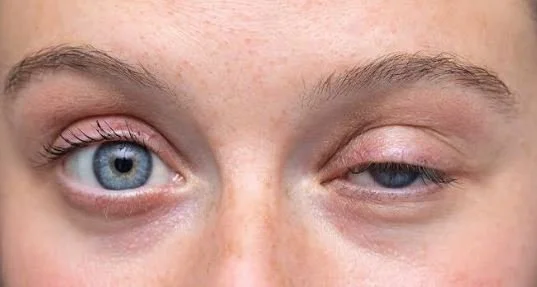
Hint: her Ct and LP are normal
Our patient had food borne-borne botulism with ptosis of the L eyelid. She lived on a farm and had consumed home-canned beans. The beans had been canned with boiling water which reaches only 212 degrees and does not kill botulinum spores. A pressure canner is recommended because it raises the temperature to 240 degrees inside the jars eliminating the spores.
Botulism is a neuroparalytic disease leading eventually to respiratory paralysis. It almost always begins with cranial nerve palsies.
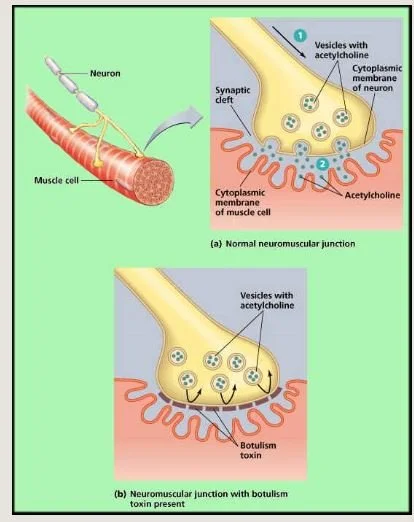
botulism is a pre synaptic acetylcholine receptor blocker
Cranial nerve involvement in botulism typically presents as the classic "four D's": diplopia (double vision), dysarthria (slurred speech), dysphagia (difficulty swallowing), and dry mouth/throat,
The cranial nerve palsies include:
Oculomotor (III, IV, VI)- leading to ptosis, blurred vision and diplopia
Facial VII- leading to facial weakness; often bilateral
Glossopharyngeal/vagus (IX,X) -leading to hoarseness and absent gag
Autonomic -leading to dilated pupils, smooth muscle paralysis occurs later with urinary retention.
THE TYPES OF BOTULISM
Food borne- antibiotics are not recommended because lysis of intraluminal botulinum can increase the amount available for absorption. There was an outbreak of botulism reported in infant formula in 2026
Infant--Ingestion of honey or soil containing spores is the most common source. Since the spores are ingested and lysed in the gut it can occur up to a month after exposure. In 2026 there was an outbreak caused by botulinum spores in infant formula. Antibiotics are not recommended because lysis of the intraluminal organisms will increase the amount of toxin available. Children less than one year of age are given human -derived botulism immune globulin.
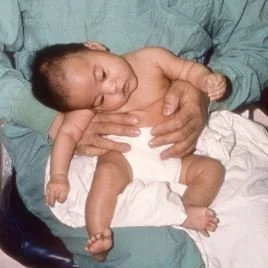
infant with no muscle tone secondary to botulism
Iatrogenic – there is a risk of botulism from botox injections. Multiple cases have been reported of diplopia, dysphagia and dysphonia with a delayed course reported up to three weeks post injection.
Wound botulism -gas gangrene is a complication of wound infection with Clostridium.
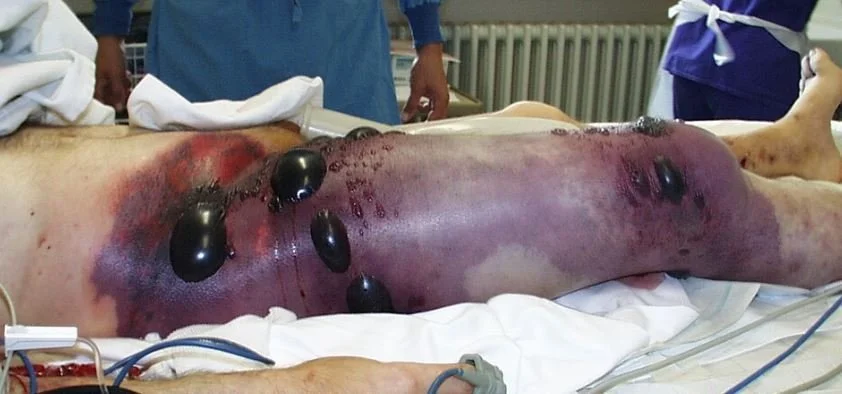
a case of gas gangrene requiring amputation.
Inhalational botulism-is a possible bio-weapon in the aerosolized form. In the inhaled form symptoms begin 12 to 72 hours after exposure. The US successfully produced botulinum toxin at Fort Detrick during WWII. The Allies stockpiled a million doses of antitoxin in preparation for the Normandy invasion. It was never used.
THE CLINICAL PRESENTATION
Clinically the patients are afebrile, sometimes with anticholinergic findings like dilated pupils or dry mouth, and develop a symmetric descending flaccid paralysis. Botulism is dose dependent and people eating the same contaminated food may not all get the same symptoms or with the same time course. The history will be very important to narrow the differential. Many neurotoxins can initially be considered. including the Miller Fisher variant of Guillan Barre, myasthenia , tick paralysis, shellfish or tetrodotoxin, encephalitis, polio, lyme and heavy metal poisoning.
TREATMENT
The treatment is heptavalent botulinum antitoxin. It is equine derived and purified. Return of synaptic function requires the development of a new presynaptic terminal which takes six months although symptoms improve more quickly after injection . The antitoxin starts working in 24-72 hours with full effect at 14 days.
Serum testing in our patient confirmed the presence of botulinum toxin type A and she was treated with antitoxin. She recovered completely in two months.
FUN FACTS
Italy has one of the highest rates of botulism in Europe. The number one cause was home canned food. Low acid foods are most likely to contain botulism . An outbreak in Italy was traced to olives.
Animals also get botulism. Outbreaks are common in the western US among gulls, ducks and loons. Dogs, cats and pigs are relatively immune.
Leiblein M, Wagner N, Adam E, et al. Clostridial gas gangrene-a rare but deadly infection:case series and comparison to other necrotizing soft tissue infection. Orthop Surg.2020Oct 4;12(6):1733-47.
Barbosa M, Batista M, Carneiro D, et al. Foodborne botulism with isolated cranial nerve involvement in a young adult. Cureus. 2025 Nov 17;17(11):e97040.
Clinical spectrum of botulism. Cherington M. Muscle Nerve. 1998;21:701–710.
Lonati D, Schicchi A, Crevani M, et al. Toxins(Basel)2020;12:509.
Richardson J, Viviano S. from beauty to botulism: a case report highlighting the rare risk of botox administration. Cureus 2024.Feb 12;16((2):e54090
Scalfaro C., Auricchio B., Anniballi F., De Medici D. Foodborne botulism: An evolving public health challenge. Infect. Dis. 2019;51:97–101.
Song Y, Li J, Ren Y, et al. Case report: botulism associated with cosmetic BoNT-A injections. Front Pharmacol. 2025 Oct 14;16:1680693.
Landau M., Klein J., Leizgold F. R., Kroumpouzos G. (2024). Rare and novel complications of botulinum neurotoxin type A and dermal filler injections. Clin. Dermatol. 42, 701–708.